
We stand at a fascinating inflection point in the history of technology. For decades, our interaction with the digital world has been defined by graphical user interfaces (GUIs)—windows, icons, menus, and pointers. But what if that’s all about to change? Two recent, thought-provoking videos paint a picture of a future where the very concepts of software and user interfaces are being rewritten before our eyes.
The first, “The Weird Death Of User Interfaces,” explores the stagnation of UI innovation and the rise of AI-driven interactions. The second, a talk by Andrej Karpathy, former Director of AI at Tesla, introduces the paradigm shift from traditional coding to “Software 3.0,” where natural language and large language models (LLMs) are the new programming primitives.
By dissecting and merging the ideas from these two videos, we can begin to understand the profound changes that are not just coming, but are already here. We’ll explore how the evolution of software is inextricably linked to the future of user experience, and what that means for developers, designers, and users alike.
The Stagnation and Rebirth of the User Interface
According to “The Weird Death Of User Interfaces by Enrico Tartarotti”, we’ve hit an “S-curve ceiling” in UI innovation. While aesthetics have improved, the fundamental way we interact with software hasn’t changed much since the early 2000s. The video argues that users are increasingly looking for ways to bypass traditional UIs altogether, favoring AI-powered tools that can generate content or provide information directly, without the need for endless clicking and navigating.
However, the current generation of AI chatbots and voice assistants, while adept at understanding our requests, often falls short in its output, presenting information in a way that lacks clarity and user control. This has led to a proposed three-level evolution for a “post-UI world”:
- Level One: Chat + UI Side-by-Side: This approach, seen in tools like PostHog and Cursor, integrates a chat interface alongside a traditional UI, allowing users to generate complex outputs with simple text commands.
- Level Two: Merged AI and UI: Here, natural language commands are integrated directly into the UI, giving users real-time feedback and a sense of control. The experimental “Ramble” feature in Todoist is a prime example of this.
- Level Three: Interface Generators: This is the most futuristic vision, where the UI is dynamically generated on the fly based on the user’s intent. Instead of a static interface, the system builds a custom, interactive UI for each specific task.
Andrej Karpathy and the Dawn of Software 3.0
Andrej Karpathy’s talk provides the foundational context for this UI revolution. He outlines the evolution of software through three distinct phases:
- Software 1.0: The traditional paradigm of developers writing explicit instructions in a programming language.
- Software 2.0: The shift to neural networks, where the “code” is not written but learned from data. The weights and biases of the network are the parameters of the program, optimized to achieve a specific goal.
- Software 3.0: The latest evolution, powered by LLMs. Here, natural language itself becomes the programming language. We can now instruct computers in plain English, and the LLM will generate the desired output.
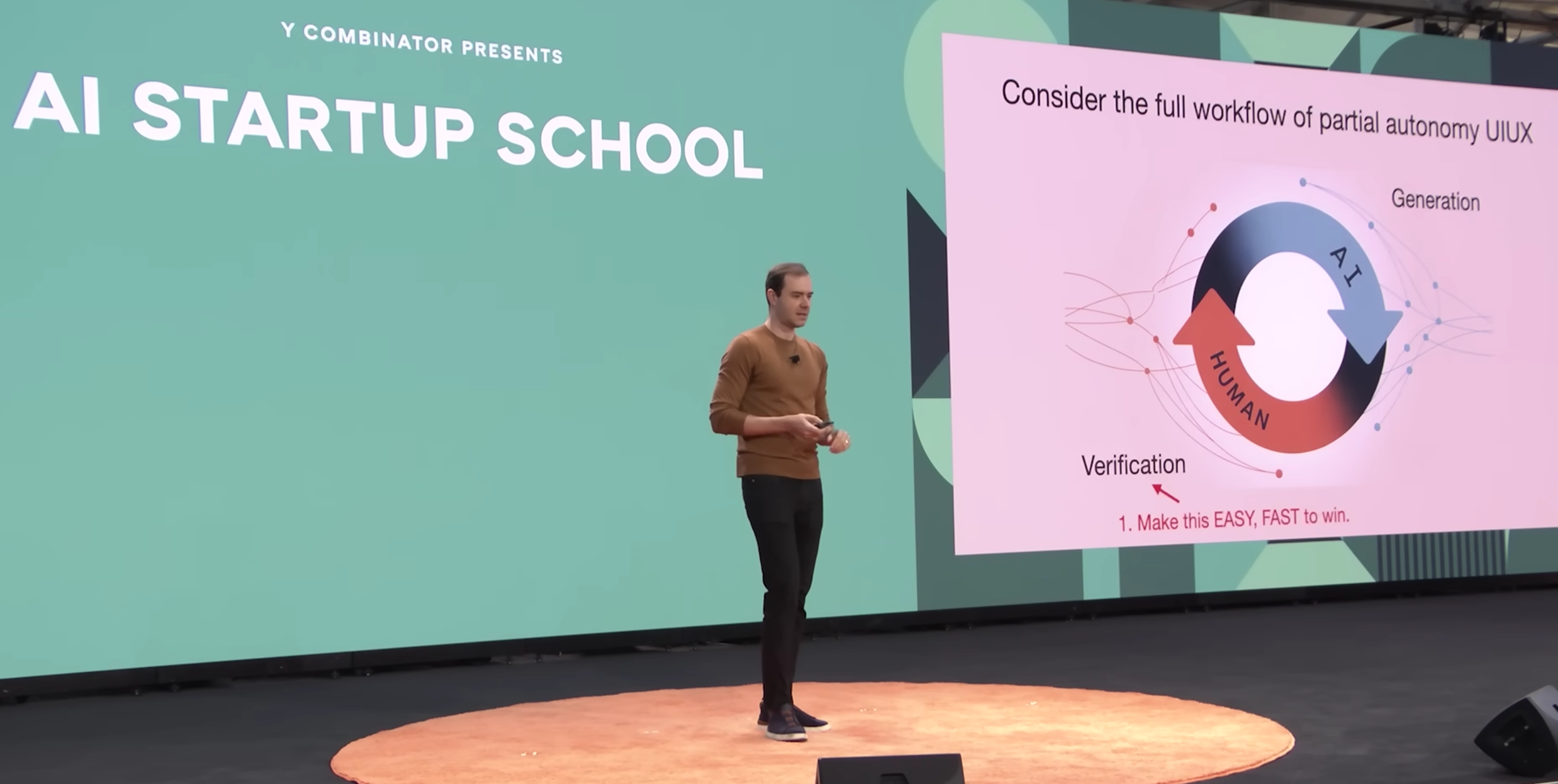
Karpathy argues that LLMs are becoming the new operating systems, with a new ecosystem of tools and applications being built on top of them. He cautions against jumping straight to fully autonomous AI agents, advocating instead for “partial autonomy apps” that act as “Iron Man suits” for users, augmenting their abilities rather than replacing them entirely.
The Convergence: Where Disappearing Interfaces Meet Software 3.0
When we place these two ideas side-by-side, a clear and compelling picture of the future emerges. The “weird death” of user interfaces is not an isolated event; it’s a direct consequence of the rise of Software 3.0.
- The “Why” and the “How”: Karpathy’s talk explains why the UI is changing so dramatically. The shift to Software 3.0 provides the underlying mechanism for the UI evolution described in the first video. The three levels of the post-UI world are, in essence, different stages of applying Software 3.0 principles to user-facing applications.
- “Iron Man Suits” as the New UI: The “Level One” and “Level Two” UIs are perfect examples of Karpathy’s “partial autonomy apps.” They don’t replace the user but rather provide powerful new tools for them to wield. The user is still in control, but their capabilities are vastly augmented by the AI.
- Interface Generators as the Ultimate Expression of Software 3.0: The “Level Three” vision of dynamically generated interfaces is the ultimate fulfillment of the Software 3.0 promise. In this world, the AI doesn’t just understand our commands; it anticipates our needs and builds the perfect tool for the job, right when we need it.
Project Ideas for a Software 3.0 World
This new paradigm doesn’t just change how we use software; it opens up a universe of possibilities for what we can build. Here are a few project ideas that emerge from this synthesis:
1. A New Operating System for Human-AI Collaboration
Imagine an OS built from the ground up for the Software 3.0 era. This OS wouldn’t just manage files and run applications; it would manage context and intent.
- Core Components: Basic information like network details, contacts, and user preferences would reside at the OS level. It would also feature a robust system for navigating action history and managing long-term memory for the AI.
- UI Blueprints: The OS would contain a library of UI generator blueprints, allowing AI agents to construct applications on the fly that are consistent and intuitive. The goal is to create partial autonomy applications where the AI handles the heavy lifting, but the human is always in the loop.
2. The Human Verification Fastlane
As AI generation speed accelerates, the bottleneck becomes human verification. We need UIs designed specifically to make this process faster and more efficient.
- Visual Auditing: These interfaces would visually present AI-generated content (code, text, designs) in a way that allows for rapid scanning and approval.
- The Autonomy Slider: A key feature, as Karpathy suggests, would be an “autonomy slider.” This allows the user to keep the AI “on a leash,” dialing up the level of automation for routine tasks and dialing it down for critical, nuanced work.
3. Curing AI Amnesia and Understanding its Psychology
LLMs suffer from what Karpathy calls “anterograde amnesia”—they don’t natively learn from interactions. They also exhibit cognitive quirks like hallucinations, gullibility, and jagged intelligence.
- Building Memory Systems: A huge opportunity lies in building external memory and context management systems for these models. This would allow an AI agent to remember past conversations, learn user preferences, and build a persistent understanding of the world.
- Designing for Quirks: By understanding the “psychology” of LLMs, we can design applications that play to their strengths and mitigate their weaknesses, creating a more reliable and trustworthy user experience.
4. An Incentivized, AI-Readable Web
Currently, much of the web’s information is declarative and optimized for human eyes, not AI consumption.
- A New Data Ecosystem: We can build platforms that incentivize creators to produce high-quality, raw, machine-readable data. This could be anything from well-structured articles and datasets to raw, unedited thoughts and mind trails.
- Organizing for LLMs: This new web would be organized for LLMs to consume efficiently, creating a richer, more reliable foundation of knowledge for future AI systems to build upon.
The Future is a Conversation
The convergence of these two ideas signals a move away from the rigid, structured world of traditional software and towards a more fluid, conversational, and intuitive mode of interaction. The future of technology is not about learning complex interfaces, but about having a dialogue with our tools.
As developers, this means we need to think less about designing static screens and more about creating systems that can understand and respond to human language. For designers, the focus will shift from pixel-perfect layouts to defining the rules and components that AI can use to generate UIs on the fly. And for users, it means a future where technology is more accessible, more powerful, and more seamlessly integrated into our lives than ever before.
The death of the user interface as we know it is not something to be feared. It’s the sign of a new beginning, a new era of human-computer collaboration that is only just getting started.
References
- The Weird Death Of User Interfaces. (n.d.). YouTube. Retrieved September 13, 2025, from https://www.youtube.com/watch?v=KG4ONHqF1qg&ab_channel=EnricoTartarotti.
- Karpathy, A. (n.d.). Software Is Changing (Again). YouTube. Retrieved September 13, 2025, from https://www.youtube.com/watch?v=LCEmiRjPEtQ&ab_channel=YCombinator.